Hybrid edge-cloud framework
A validated architecture distributing computation between edge devices (local pre-processing and pseudonymisation) and cloud infrastructure (scalable analytics) for real-time biomedical workflows.
MediVerse turns natural-language questions into validated SQL and renders the results as interactive 3D visualisations inside a head-mounted display. No code, no menus - just ask.
MediVerse is the visualisation arm of a doctoral research programme at Western Sydney University that addresses four field-level gaps in biomedical informatics: the absence of validated hybrid edge-cloud architectures for real-time analytics, the lack of cohort-aware compression methods for omics data, limited integration of natural-language interfaces with immersive analytics, and the absence of a unified evaluation framework for AI-driven immersive visualisation.
Existing infrastructures remain fragmented, failing to simultaneously address scalability, efficiency, privacy, and accessibility for non-technical users. Multi-dimensional genomic, clinical, and imaging data also exceed what 2D desktop interfaces can effectively communicate. This work proposes a unified architecture that lets frontline clinicians and researchers query and explore complex datasets through their voice, inside a virtual reality environment - without writing SQL and without leaving an immersive workspace.
Validated on paediatric leukaemia and de-identified paediatric tumour cohorts.
The research is structured as four contributions covering how biomedical data are stored, compressed, analysed, and visualised. Three are already published; the fourth is in preparation.
A validated architecture distributing computation between edge devices (local pre-processing and pseudonymisation) and cloud infrastructure (scalable analytics) for real-time biomedical workflows.
A lossless compression method that exploits global redundancy patterns across entire patient cohorts rather than individual files, using N-gram analysis to build dictionaries that are deployed back to edge nodes.
A generalised voice-driven immersive analytics architecture that translates natural-language questions into validated SQL via an LLM, then renders results as interactive 3D visualisations inside a head-mounted display.
A unified metric suite of six operationalised metrics across three dimensions - Rendering Quality, AI Decision Quality, and Explanation Quality - enabling diagnostic precision and cross-system comparison for AI-driven immersive visualisations.
A short demonstration of the voice-driven workflow on a paediatric leukaemia case study.
The MediVerse system has been evaluated on two paediatric oncology cohorts, exercising both structured clinical queries and integrated multimodal genomic analysis.
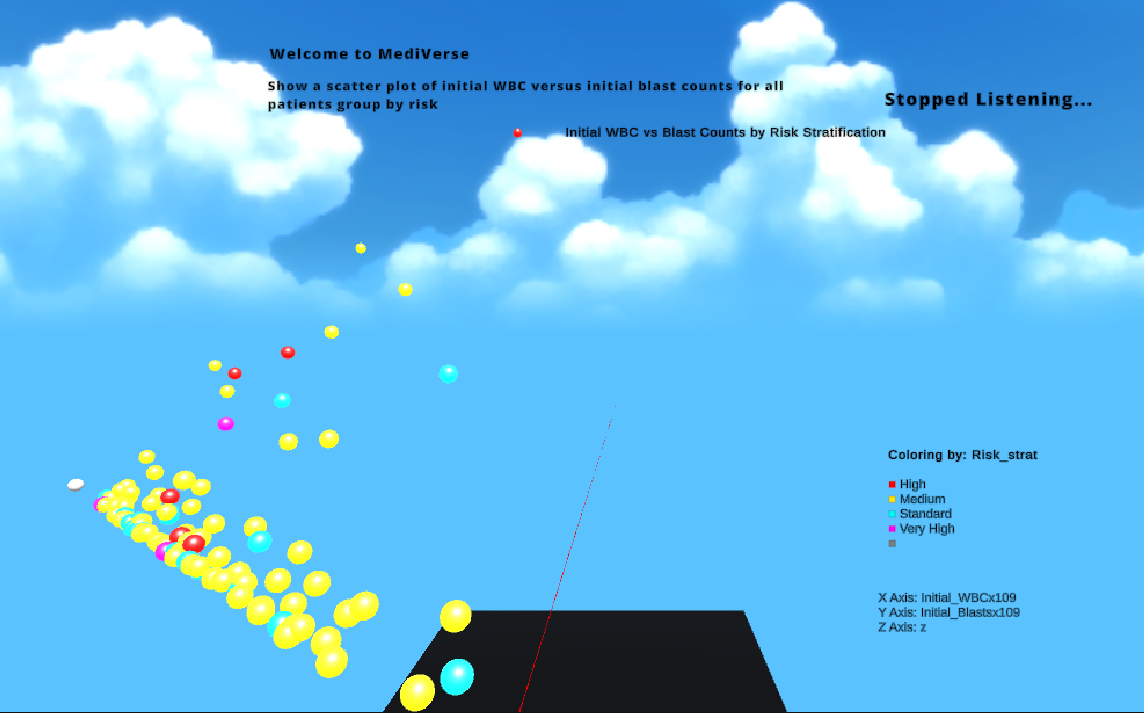
From schema definition and CSV import to voice-driven 3D scatter plots and synthesised clinical explanations, illustrated on 247 paediatric leukaemia patients.
Read case study →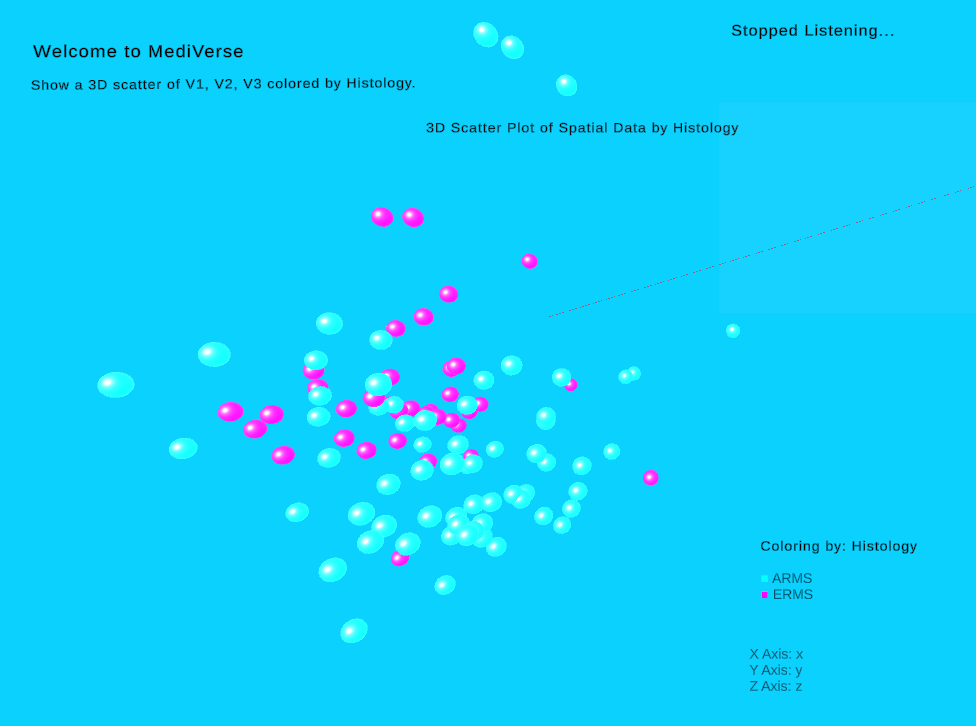
Integrated exploration of gene expression matrices and clinical metadata across 101 paediatric tumour samples, including ERMS/ARMS comparison and PAX3 expression profiling.
Read case study →The MediVerse programme is supported by a series of peer-reviewed publications covering the underlying edge-cloud framework, an efficient omics-data compression scheme, the immersive voice-driven analytics system itself, and a forthcoming evaluation metric suite.
Pacific Rim International Conference on Artificial Intelligence (PRICAI 2025), pp. 35-50. Springer Nature Singapore.
This paper introduces MediVerse, a system that integrates voice-based natural-language interfaces, immersive VR visualisation, and large-language-model query translation to enable real-time, hands-free interaction with complex biomedical datasets. The platform uses head-mounted VR displays for voice input, a cloud-based LLM for schema-aware query interpretation, and real-time 3D rendering of the resulting data. Evaluation across 20 seed queries on paediatric leukaemia (247 patients) and a de-identified paediatric tumour gene-expression cohort (101 samples) demonstrated accurate user-intent interpretation, low-latency responsiveness, and the correct selection of immersive visualisations in 95% of cases.
Journal of Sensor and Actuator Networks, vol. 14, no. 2, art. 41 (2025).
The growing complexity and volume of genomic and omics data present critical challenges for storage, transfer, and analysis on edge-cloud platforms. This paper introduces a lossless compression method that integrates Trie-based shared dictionaries within an edge-cloud architecture. N-gram analysis identifies repeated sequences across entire patient cohorts; the resulting global dictionary is deployed to edge nodes for localised preprocessing, reducing redundancy before cloud transmission, where additional compression is then applied. Evaluation on B-ALL (178 patients, 7.92 GB) and CLL (162 patients, 3.98 GB) datasets achieved 68.2% reduction in file size compared with 57.9% for traditional ZSTD - an additional saving of approximately US $676 per year at this scale - while maintaining compatibility with standard bioinformatics pipelines.
Innovations in Digital Health, Diagnostics, and Biomarkers, vol. 4, pp. 81-88 (2024).
The healthcare landscape is rapidly integrating diverse data sources - electronic health records, omics, and genomic data - into unified patient profiles, enhancing personalised medicine and interoperability. This transformation, however, faces growing challenges in data integration and analysis. This study introduces a novel hybrid edge-cloud framework designed to manage the surge of multidimensional genomic and omics data in healthcare. It combines the localised processing of edge computing with the scalable resources of cloud computing, evaluated on simulated B-cell acute lymphoblastic leukaemia (B-ALL) and chronic lymphocytic leukaemia (CLL) cytometry datasets. The architecture achieved 56% data reduction, 57% faster upload times, enhanced privacy through local pseudonymisation, and projected annual cost savings of approximately US $4,679 on a 40 TB workload.
Manuscript in preparation.
Existing evaluation practices for AI-driven immersive visualisation systems rely on static, single-axis metrics that fail to capture the joint quality of rendering, model decisions, and post-hoc explanation. IVEM (Immersive Visualisation Evaluation Model) introduces a unified metric suite of six operationalised metrics across three dimensions - Rendering Quality, AI Decision Quality, and Explanation Quality - validated on paediatric leukaemia and de-identified paediatric tumour gene-expression datasets. The suite enables diagnostic precision and objective cross-system comparison for AI-driven immersive analytics, complementing the MediVerse architecture introduced in earlier work.
A cross-institutional team spanning computer science, AI, biomedical research, and paediatric oncology.
Rani Adam
PhD candidate, School of Computer, Data and Mathematical Sciences, Western Sydney University.
Assoc. Prof. Quang Vinh Nguyen
School of Computer, Data and Mathematical Sciences, Western Sydney University.
Prof. Daniel R. Catchpoole
The Tumour Bank, Children's Cancer Research Unit, Kids Research, The Children's Hospital at Westmead; The University of Sydney; UTS.
Prof. Simeon J. Simoff
School of Computer, Data and Mathematical Sciences, Western Sydney University.
Dr. Zhonglin Qu
School of Computer, Data and Mathematical Sciences, Western Sydney University.
Prof. Paul J. Kennedy
Australian Artificial Intelligence Institute, Faculty of Engineering and IT, University of Technology Sydney.
MediVerse is a research collaboration supported by an Australian Government Research Training Program scholarship.
If you would like to see a live demonstration, discuss a collaboration, or request beta access to the platform, please reach out.